Every monitoring tool has to get the data somehow. Either a small program runs on the machine and reports what it sees, or something outside asks the machine questions. Both are right for different things, and most networks need both.
What each one sees
| Agent | Agentless | |
|---|---|---|
| CPU, memory, every disk | Yes, from inside | Partly, if the device publishes it (SNMP, WMI) |
| Disk health (SMART) | Yes | Rarely |
| Processes and services | Yes | Services over WMI on Windows; little elsewhere |
| Files, such as backups | Yes | No |
| Installed software | Yes | Partly, over WMI |
| Switches, UPS units, printers | No: they cannot run one | Yes, over SNMP |
| Websites and public ports | Not needed | Yes, from outside |
What each one needs from the network
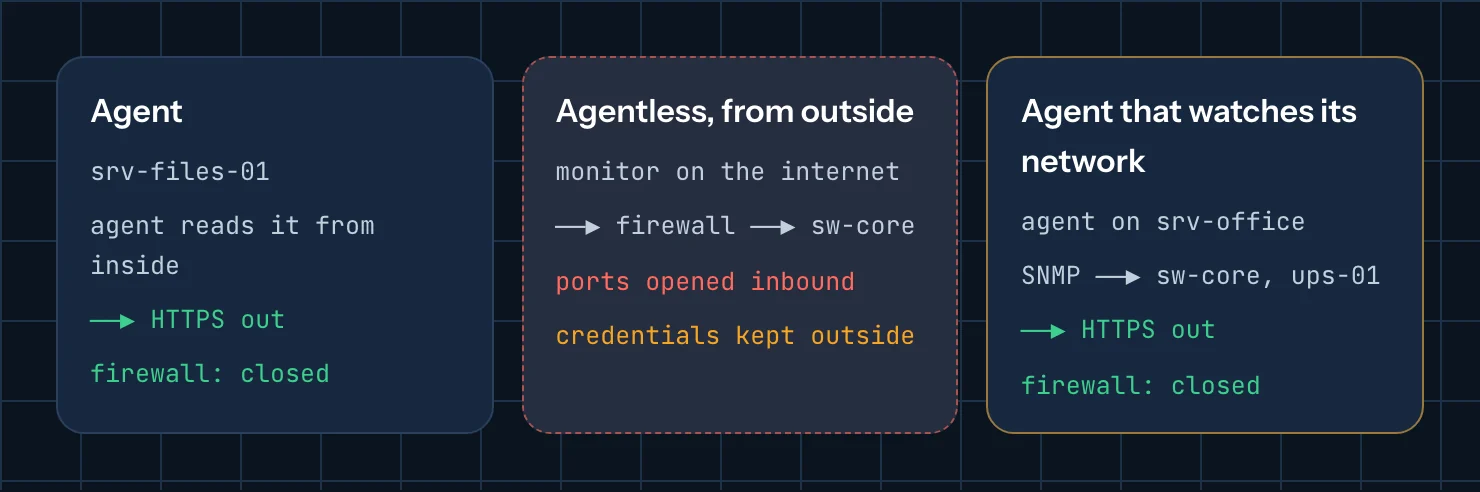
An agent connects outbound to the monitoring service, usually over HTTPS. Nothing has to be opened on the machine or the firewall.
Agentless monitoring is the other way around: the monitor has to reach the device. From the internet that means opening ports on the customer’s firewall, or a VPN; for SNMP it also means storing a community or a v3 user for every device. That is why agentless checks work best when they are made from a machine already inside the network.
How each one fails
They fail differently, and a monitoring system has to handle both.
An agent can stop. The service crashes, the machine powers off, the network link drops. From the outside that looks like silence, so silence has to raise an alert, and the agent should keep its readings while the link is down and send them when it comes back.
An agentless check can lie about the device when the path is the problem. A switch that does not answer may be down, or the route to it may be. Checks made from inside the same network, and alerts that know which devices depend on which, avoid forty alerts for one broken uplink.
The middle way: an agent that also watches its network
The agent on a server inside the customer’s network can query the devices around it over SNMP, WMI, ping or TCP, and send everything out over the same outbound connection. The firewall stays closed, and switches, UPS units and printers are watched from the closest possible place.
Which one for each device
| Device | Use | Why |
|---|---|---|
| Linux, macOS or Windows server | Agent | It sees everything and needs no inbound port |
| Workstations | Agent | Same reason, and they move between networks |
| Switches, firewalls, access points | Agentless (SNMP) from inside | They cannot run an agent |
| UPS units and printers | Agentless (SNMP) from inside | Battery, runtime and toner are published over SNMP |
| Windows machines you cannot install on | Agentless (WMI) from inside | WMI answers many questions remotely |
| Websites and public APIs | Agentless from outside | What matters is what a visitor sees |
| Hypervisors | Agent plus its API | The API knows the guests and their backups |
How Sergward does it
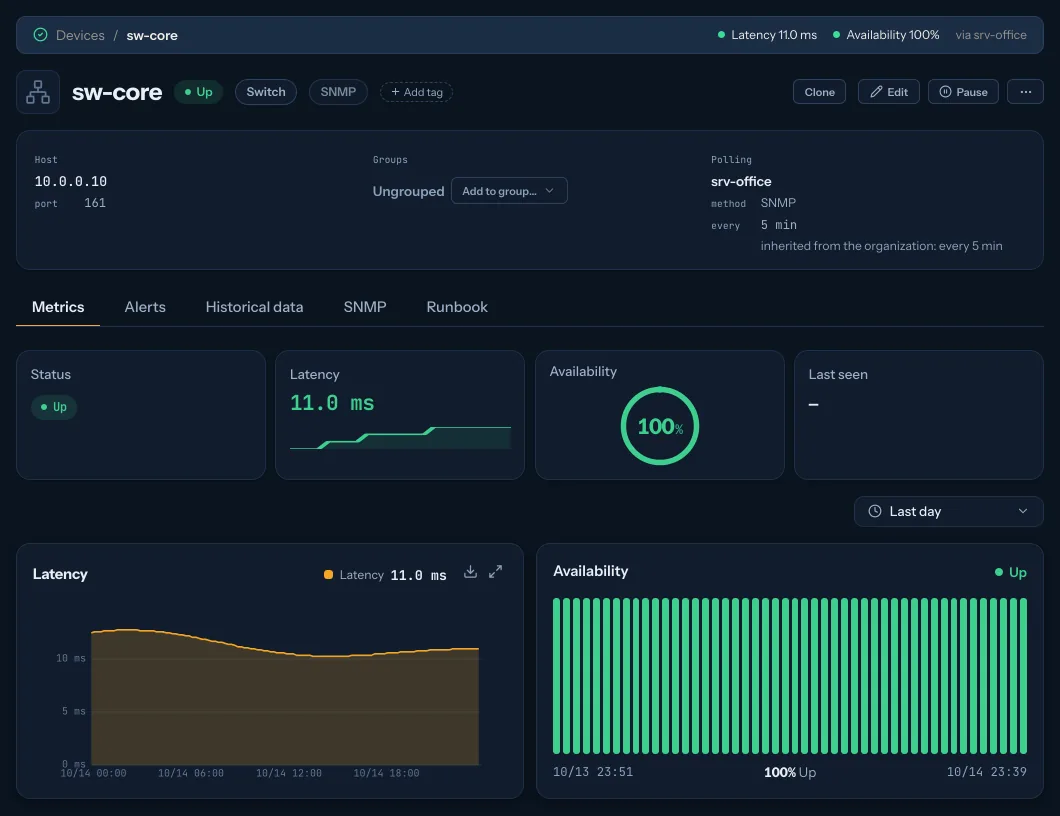
Sergward uses both. An agent for Linux, macOS and Windows reads each server from inside and only connects outbound over HTTPS. The same agent queries the devices on its network that cannot run one: switches, UPS units and printers over SNMP v1, v2c or v3, Windows machines over WMI, anything over ping or TCP. Websites are checked from the Sergward platform, from outside. Devices with a public address can also be polled from the platform over SNMP or TCP; the platform never pings, ping always comes from an agent inside the network.
A machine or device that stops reporting raises an alert, and when a gateway goes down the devices behind it stay quiet so that one email goes out instead of forty.
Sources, read on 15 October 2026
- RFC 3411: An Architecture for Describing SNMP Management Frameworks
- RFC 3414: User-based Security Model (USM) for SNMPv3
- RFC 1901: Introduction to Community-based SNMPv2
- Microsoft Learn: Connecting to WMI on a remote computer
- Microsoft Learn: Connecting to WMI remotely, firewall settings
Frequently asked questions
What is agentless monitoring?
Monitoring a device from outside with protocols it already speaks, such as SNMP, WMI, ping, TCP or HTTP, without installing anything on it.
Is an agent less secure than agentless monitoring?
It depends on the direction of the connection. An agent that only connects outbound opens no port on the machine, while agentless monitoring needs the monitor to reach the device and usually holds credentials for it.
Can a switch or a UPS run an agent?
No. Network devices and appliances are monitored agentless, usually over SNMP, from a machine that can reach them.
What happens when the agent itself stops?
The machine goes quiet. A good monitoring system treats that silence as an alert instead of a gap in the chart.